Why faster, cheaper, and better don’t have to be a trade-off
Shift left is a term from software development. It means moving a step earlier in a process, doing something sooner instead of later, because catching a problem early is dramatically cheaper than catching it late. Barry Boehm and Victor Basili quantified this principle: a defect caught during requirements and design is often up to 100 times cheaper to fix than the same defect caught after release, on a large system; on a smaller, less critical one, the gap is closer to five times. Larry Smith named this shift-left discipline in 2001, moving testing and security earlier in the development cycle for exactly this reason. The logic has held for over twenty years because it’s simply true.
That’s the narrow definition. The broader definition means putting the work, and the tools to do the work, closer to, or directly into the hands of, the person who has the idea and runs the business. Not shifted to a specialist who translates it for them. Shifted to them.
Done properly, this has a second effect that is harder to anticipate. It doesn’t just move the work. It simplifies it: fewer tools, fewer stages, fewer places for the truth to get lost between one stage and the next. Shift left and simplify aren’t two separate benefits. They’re the same change, seen from two angles. You don’t get one without the other.
Why work has always moved right
Most work has moved the opposite direction for as long as anyone can remember. Someone who runs the business, a claims manager, a plant supervisor, a sales ops lead, knows exactly how the work should go. They couldn’t say it in a language a designer, an engineer, or a compliance reviewer could act on, so the idea moved right instead: to a business analyst, who wrote it up for a product manager, who handed it to a designer, who handed it to an engineer, who handed it to QA. Every handoff was a translation. Every translation cost time and lost something the original person meant.
That chain was never incompetence. It existed because turning an idea into something built required skills the person with the idea usually didn’t have themselves: how to structure a requirement, how to design an interface that meets an accessibility standard, how to write code that passes a security review. Shifting left was never really about speed. It was about whether the person with the idea could do the downstream work themselves. Mostly, they couldn’t.
What AI actually changes
AI changes that calculus directly. It isn’t that the specialist stops mattering, and it isn’t that the handoff disappears. The handoff still happens. What changes is what gets handed off, and when. The expert who used to translate every case by hand, one request at a time, now sets the standard once: the rule, the pattern, the regulation, the approved component. That standard gets built into what the person with the idea is drawing from, so the ordinary case doesn’t need a human translator anymore. It still gets checked. It just gets checked against a standard the expert already set, instead of interpreted fresh by the expert every single time.
That’s what shift left actually means. Not “the business analyst gets a productivity tool.” Not “the business analyst is no longer needed.” It’s that the business owner needs less of the business analyst’s time on the routine case, and more of it on the standard itself, and on the case unusual enough to actually need their judgment. Less mundane translation, done over and over. More of the judgment only they can make, done once and reused.
Most of what’s sold as AI shifting left doesn’t do this. It shifts the chain by one link, not by breaking the chain apart. The developer still gets the ticket and still writes the code, just with a copilot suggesting the next line. That’s real, and it isn’t nothing. But it’s the same chain, moved slightly left, with the same people doing the same mundane work, just faster.
Shift left, hard
Ordinary shift left moves work to someone who can do it faster. Shift left hard moves the standard itself into the tool that person is using, so what they produce is already correct against that standard before anyone reviews it. Not a faster path to the same check. A check that’s already been passed by the time there’s anything to look at.
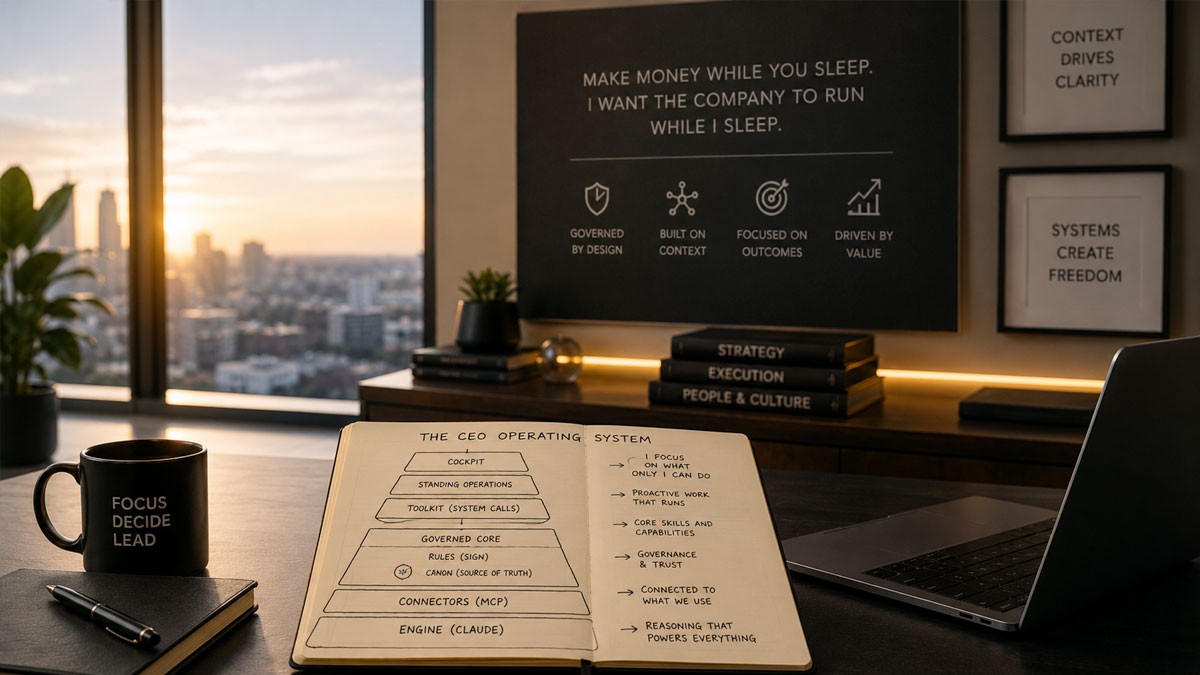
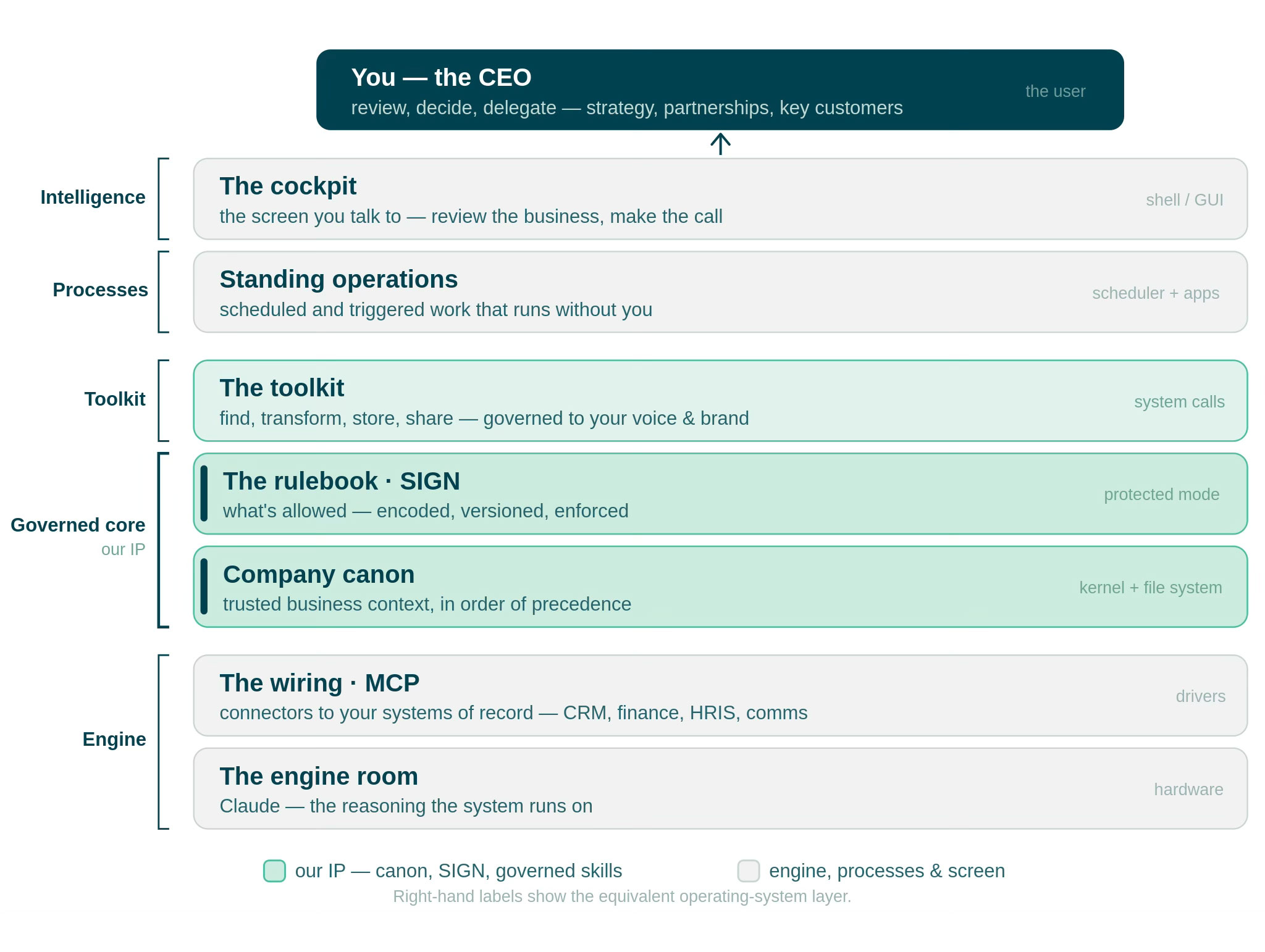
That only works if the standard is actually built into what’s generating the output, not written down somewhere and left for a person to remember and apply. We call the governed version of that standard Canon, In Design this is: the design patterns, the usability rules, the accessibility requirements, the regulatory constraints, the approved components, and the business rules behind all of it, compiled into a form the system draws from directly. The system doesn’t produce an off-brand color or a non-compliant component because neither one exists in what it’s drawing from. It isn’t skipping a check. There’s nothing to check, because the violation was never an option to begin with.
Here’s what that changes for the person who used to catch it. The risk hasn’t moved. It’s still sitting at the same step, with the same person who always caught it. What’s different is how much of it still needs their attention: next to none for the routine case, because it’s already correct. What’s left for them to review is the real exception, and that’s the part that gets faster, not skipped.
One source, or it doesn’t work
Shift left hard has a requirement that’s easy to state and hard to actually do: all of it has to live in Canon. Not most of it. Not the parts that were easy to write down. If the standard is still split across application code, a policy document, a prompt someone wrote into an AI tool, a skill definition, a RAG search over a SharePoint drive, and the memory of whoever’s been doing the job the longest, the system is still guessing. It’s just guessing from more places at once, faster. Canon isn’t one more place knowledge lives. It’s the source all the others call, instead of building their own copy of the rule in. Code doesn’t encode the eligibility logic anymore; it calls Canon for it. A prompt or a skill doesn’t restate the standard from memory; it calls Canon for it too.
And it has to be the same Canon, for everyone drawing from it, at the same time. A human and an agent working from two different versions of the standard, one from a wiki someone updated last year and one from whatever the model happened to learn, will produce two different answers to the same question. That’s not a governance gap to patch later. That’s the exact same fragmentation this piece has been describing, just moved into the AI layer instead of out of it.
Here’s what that actually looks like day to day. When I’m working on a design in Claude and it places something a certain way, sizes it a certain way, picks one pattern over another, I can ask why. Not asking it to guess at its own reasoning. Asking which rule it followed, and where that rule lives. It should be able to point to the actual standard in Canon behind that decision. Then I get to make the real call, not “was the AI right,” but “was the rule right.” Sometimes the rule stands and so does the design. Sometimes it doesn’t, and now I know exactly which rule to go fix, for every output after this one, not just this one.
That’s the actual difference between fast and governed. Fast gives you an answer. Governed gives you an answer and the reason behind it, in a form you can actually check and correct.
Simplify: the paint chip problem
This is the simplify half of the claim, and it isn’t only about who does the work. It’s about which tools the work requires in the first place, and most of the tools built for the old chain exist to compensate for a single problem: no stage in that chain ever had the whole truth.
The old toolchain had a tool for almost every stage: a lo-fi tool for early ideas, a hi-fi design tool for the visual layer, a separate prototyping tool to make it clickable, then a design-to-code handoff into whatever engineering used. Each one holds part of the deliverable. A tool like Figma keeps the paint chip: the exact color, the font, the pixel spacing of a component. It doesn’t keep the rule for where that paint chip is allowed to go: which component is approved for which context, what an accessibility standard requires of a given interaction, which regulation constrains a specific field or disclosure. That rule lived somewhere else entirely: a style guide nobody opened, a senior designer’s memory, a compliance sign-off applied by hand, differently, every time.
Canon is where both halves live together: the component and the rule for using it, in the same place. Once a system generates output directly from that, the intermediate tools stop being necessary. Not because they got faster. Because the reason they existed, carrying half a truth from one stage to the next so the next stage could find and apply the other half, is gone. A lo-fi tool, a hi-fi tool, a separate prototyping tool, a separate accessibility audit: four different attempts to reassemble a whole truth that was never in one place to begin with. Put the whole truth in one place and you don’t need four tools to approximate it. You need one system that already has it.
What this looks like in minutes, not weeks
Here’s where the distinction between shift left and shift left hard actually shows up. Ordinary shift left, even done well, still means the idea enters a queue. A designer has to be available. A developer has to pick up the ticket. Even a well-run team with short cycles is still waiting on someone’s calendar, and that wait, not the work itself, is often the biggest cost in the whole chain. Weeks pass before anyone finds out whether the idea was even worth pursuing.
I can take an idea, something as unformed as a sentence, and build a full, high-fidelity prototype of it in a few minutes: on-brand, accessible, built from approved components, checked against the usability and regulatory standards that apply to it, backed by real, working code. Not after a design slot opens up. Not after a sprint gets planned. In minutes, while the idea is still in the room. That’s long enough to settle the question that actually matters before anything else gets spent: whether it’s worth pursuing at all. Feasibility, and the go or no-go decision behind it, moves from a multi-week wait to something you can decide before the meeting ends.
If the answer is go, the acceleration doesn’t stop at the prototype. Design review against something that’s already standards-compliant is fast, because it’s confirming work that was built correctly the first time, not starting from a blank canvas. Development from there is highly automated. QA is highly automated too, checking against the same standard the prototype was already built to, instead of discovering that standard for the first time. A feature that would have taken three months to deliver end to end fits inside a two-week sprint.
That’s the real distinction. Ordinary shift left moves a check earlier in a queue that still exists. Shift left hard removes the queue for the part of the work that no longer needs one, and moves the check to every output along the way instead of a single gate at the end. It isn’t only design work that moves. It’s the analyst work that used to structure the request, the product manager’s work of grooming a backlog item until it was ready, the project manager’s work of sequencing whose turn was next. A business leader with an idea can build the prototype themselves, in minutes, absorbing pieces of all four roles’ work for that one instance. The people who used to do that work don’t disappear. Their judgment moves to setting the standard, running the review, and owning the exception, the part of the job a queue was never actually protecting.
What this is worth, at a scale we can already measure
You don’t have to take the larger claim on faith. A narrower version of it has already been measured, at companies that never went further than a shared design system: a governed set of visual components (paint chips), still built and maintained by hand.
Airbnb’s design system cut its combined UI design, development, and testing time by 60 percent. Westpac’s GEL system cut design time by 66 percent and pushed UI design output up sevenfold. VMware prevented roughly 30 percent of accessibility bugs before they ever reached QA. Figma found that teams working from an up-to-date design system completed design tasks 34 percent faster than teams without one. None of those companies had gone further than the paint chip, consistent components, consistent visual rules, still requiring a team of humans to build the system and keep it current.
This isn’t a design story
Everything above made its case through design, because it’s the clearest version: everyone can see a color, a component, an accessibility violation, and judge immediately whether it’s right. But nothing about the mechanism is specific to design. The same shift applies anywhere a process runs on a standard that currently lives in a document, a policy, or someone’s head instead of in the system doing the work.
An underwriting decision has a standard: the rules that determine what qualifies, what doesn’t, what needs an exception. A contract review has a standard: the clauses that are approved, the language that isn’t, the terms that trigger legal sign-off. A benefits eligibility call has a standard: the policy as written, not the version the rep half-remembers from a training two years ago. In every one of these, the same failure shows up when you shift left without shifting the standard with it: someone moves faster, and the risk sits exactly where it always sat, waiting for a reviewer who now has more of it to get through, faster, with less time to catch it.
Shift left hard means the same thing everywhere it applies: the standard, whatever it is for that process, gets compiled into what the person or the agent is drawing from, before they act, not checked after. Design is just an example you can visualize.
Fast, cheap, and good, together
We don’t have a measured number yet for what happens when business rules join the visual layer in the same governed system, the way Airbnb or Westpac measured their design systems on their own. What we can reasonably project: if a consistent paint chip alone is worth a 60 to 66 percent cut in design and development time, adding the layer that actually causes most rework, the rule, the exception, the regulation nobody wrote down in the first place, should compound that, not just add to it. A design system reduces visual rework. It doesn’t touch the rework that comes from a wrong business rule reaching code in the first place. By the research above, that’s a different, and likely larger, share of the cost.
Shift left hard doesn’t make the old steps faster. It removes them. What that’s worth isn’t just a speedup multiplier on the new process. It’s the up-to-hundred-times penalty the old process used to pay for catching things late, that a removed step no longer incurs at all.
Traditional process improvement almost always trades one thing for another: fast, cheap, or good, pick two, is one of the oldest observations in the discipline. Shift left hard breaks that trade, because the same mechanism drives all three at once:
- Fast. Feasibility that used to take weeks takes minutes, development that took months takes weeks; a feature that used to take a quarter fits inside a two-week sprint, because the standard is compiled into the work before it’s built, not checked after.
- Cheap. Faster delivery is lower cost, and the defect that would have cost up to a hundred times more to catch downstream is never introduced in the first place.
- Good. It’s not just good, it is very good. Requirements come from the person who actually had the idea, written directly into the prototype, and carry through unchanged and to standard, all standards.
Shift left hard doesn’t trade fast against cheap against good. It delivers all three, from the same mechanism.