As organizations embed AI deeper into everyday operations, a critical question is moving to the forefront: Who controls the knowledge and intelligence created along the way?
In the Forbes article “We Are Renting Our Brains, And Nobody Reads the Lease,” technology writer Jason Snyder examines the growing risks of AI and SaaS vendor lock-in—from model deprecation and data portability to the loss of institutional knowledge accumulated inside systems an organization ultimately does not control.
Career Highways CEO Liz Eversoll contributes an important distinction to that conversation: organizations need both portability and explainability. They need the ability to act on their own data and take it with them, but they also need to understand and trust the decisions AI systems make while that data is being used.
That distinction becomes particularly important in workforce technology. Skills data represents both an organizational asset and an individual’s professional identity. When AI influences decisions about skills, roles, mobility, and opportunity, organizations need more than an answer—they need governance, traceability, and the ability to understand how that answer was reached. As Liz explains in the article, an AI system may be capable of making a decision without those foundations, but it may not be capable of defending it.
The Forbes article explores why control, portability, explainability, and trust are quickly becoming fundamental requirements for enterprise AI.
Career Highways CEO Liz Eversoll joins The TechEd Podcast to discuss how organizations can move beyond traditional job architectures and embrace skills intelligence. The conversation explores AI, workforce transformation, and practical strategies for building more agile, skills-driven talent ecosystems.
As enterprises move from chat assistants to production agents, the real constraint isn’t model intelligence — it’s the context window, and it’s denominated in tokens. This piece traces why: how text becomes tokens, why the key-value cache makes those tokens the true driver of cost, latency, and memory, and why the format you choose to represent knowledge is both an efficiency and a reasoning-quality decision. It introduces SIGN, Career Highways’ open notation, which cut a ~200-document canon by roughly a quarter versus markdown — with the deepest savings in the most governed content.
As enterprises move from chat assistants to production agent systems, a quiet architectural truth is surfacing: the binding constraint on an agent is not the intelligence of the model. It is the context window — and the context window is denominated in tokens.
Every rule, definition, and governance constraint an agent must operate under has to enter the model as tokens. There is no side channel. This piece traces a single causal chain that most knowledge-management strategies ignore: how text becomes tokens, why tokens govern the real economics of inference through the key-value cache, and why the format you choose to represent enterprise knowledge is therefore both an efficiency decision and a reasoning-quality decision — not a documentation one. It is the argument behind SIGN™ (Sigil Intelligence Graph Notation), an open specification originated at Career Highways, illustrated here with measurements against our full ~200-document canon.
Tokens are the unit of consumption
A language model cannot operate on letters or words directly; it operates on numbers. Before any text reaches the model it is segmented into tokens — typically subword chunks — and each token maps to an integer ID drawn from the model’s fixed vocabulary. Common words often become a single token; rarer strings are assembled from smaller pieces. In English, a token averages roughly three-quarters of a word, though this varies substantially with language, code, and numeric content and should be treated as a rule of thumb rather than a constant.
The consequence is that structure is not free. Punctuation, delimiters, and repeated field names are all tokenized exactly like meaningful content. A model is, mechanically, a next-token predictor rolling forward one vocabulary entry at a time — and it pays, in every sense, for each token it must carry. The question ‘how do we represent knowledge for an agent?’ is, underneath, the question ‘how many tokens does that knowledge cost, on every single call?’
The KV cache: why token count governs cost, latency, and memory
To understand why token count is so consequential, look at how autoregressive generation actually runs. The core operation of attention projects each token into a query, a key, and a value. To generate the next token, the model compares the current query against the keys of every prior token and blends their values accordingly. Naively, producing a sequence of length N would recompute every token’s projections at every step — work that scales with the square of the sequence length.
The standard optimization is the key-value cache. A token’s key and value never change once it is in the sequence, so they are computed once and stored. Each new step then processes only the single new token and reads the rest from cache, collapsing per-step work and making generation practical. Essentially every production inference stack relies on it.
The catch is where that cache lives and how it grows. The KV cache must sit in fast accelerator memory for the entire lifetime of a request, and its size grows linearly with the number of tokens in context and linearly with the number of concurrent requests. Model weights are a fixed, one-time cost; the KV cache is a per-request, per-token cost that stacks. On long contexts under real concurrency, it can rival or exceed the memory footprint of the weights themselves, and it is frequently the true reason a deployment runs out of memory or slows down — not model size, but the aggregate weight of the caches.
This reframes what a token in the context window costs. It is not merely input billed once. Each token is persistent accelerator memory held for the duration of the request, and it contributes to latency. And critically, every token spent on knowledge overhead is a token unavailable for the model’s own reasoning — a point we return to below. In an agentic enterprise running many calls per day, the representation of knowledge becomes a first-order driver of cost, throughput, hardware ceiling, and the room left to think.
The representation tax
If tokens are the currency and the KV cache is the reason they are expensive, then the encoding of enterprise knowledge is an efficiency lever hiding in plain sight. The formats teams reach for were each designed for a different consumer, and none for the agent context window as the primary unit of consumption.
Approach
Limitation for agent knowledge
JSON
Machine-readable but token-heavy. A large share of tokens is structural noise — braces, quotes, and field names repeated on every record — carrying no domain meaning. Weak at expressing relationships, constraints, or inference.
Raw markdown
Token-efficient but structurally untyped. An agent cannot reliably distinguish a hard constraint from a property or a description, and there is no relationship model.
RDF / OWL
Semantically rigorous but adoption-hostile: verbose syntax, heavy toolchain, and sparse presence in model training data, so models are not fluent in it.
Prompt engineering
Fast but ungoverned — unversioned, unauditable, and non-reusable. It does not survive scale.
The gap is not a syntax preference. It is that typed, governed knowledge and low token cost have been treated as mutually exclusive. Structure-rich formats are expensive; cheap formats are unstructured. That trade-off is the tax.
What it costs across a real corpus
SIGN is a knowledge-contract notation designed against the agent context window as its target. Its central move is the use of sigils — compact, single-glyph markers — to carry type and structure densely, so that entities, properties, relationships, constraints, inference rules, and provenance can be expressed with the fidelity of a knowledge format without the structural-noise premium a serialization format like JSON imposes.
Rather than lean on a single hand-picked document, we measured the effect across our entire canon — 198 documents with one-to-one markdown-to-SIGN coverage. Encoding the corpus in SIGN rather than markdown reduces it from roughly 372,000 tokens to roughly 275,000: about a 26% reduction against a format that is already lean, and a far larger reduction against the JSON many teams would otherwise inject.
Corpus
Markdown
SIGN
Savings
Canon core (44 docs)
109,600
87,900
20%
Tenant canon (154 docs)
262,200
187,100
29%
Combined (198 docs)
371,700
275,000
26%
The corpus-level average hides a more useful signal: SIGN’s™ savings track structural density. Prose-dominant material compresses least — general commons and domain documents land around 85% of their markdown size — because there is little structural overhead to remove. Highly structured, governance-heavy material compresses most: our top-level governance charter falls to roughly 45% of its markdown size, since that is exactly the content where typed declarations, relationships, and constraints would otherwise carry the heaviest scaffolding. The rule of thumb for builders: the more typed and relational your knowledge, the more a purpose-built notation returns.
A note on measurement
These figures are estimates from modern subword tokenizers, not official counts from a specific production model. We bracketed the corpus with two independent tokenizers; they agree to within about 0.6%, and tokenizer choice does not move the comparison. As a known property of this class of tokenizer, absolute counts tend to run somewhat below a frontier model’s own tokenizer on prose — plausibly on the order of 10–20% higher in the real model, more on heavily structured text — so treat the absolute totals as a floor and the ratios as the durable result. What is invariant under any tokenizer is the comparison itself: the format runs about three-quarters the size of markdown overall, and the savings concentrate in structured content.
From token savings to reasoning headroom
Efficiency is only half the story, and arguably the smaller half. The more consequential effect is on how well an agent can reason over its knowledge — and this arrives through two distinct channels.
The first is representational. Markdown gives an agent text to retrieve; a typed notation gives it structure to reason over. When a constraint is explicitly marked as a constraint, a relationship as a governed predicate, and a fact as asserted-versus-inferred with its provenance attached, the agent is not left inferring the shape of the knowledge from prose formatting. It can distinguish a rule it must enforce from a property it may use, traverse declared relationships rather than pattern-match across paragraphs, and weight a fact by its derivation rather than by how confidently it happens to be phrased. Each of these removes a class of misread that untyped text invites — the failure mode where an agent treats a hard mutex as a soft suggestion, or an inferred claim as ground truth.
The second channel is budgetary, and it ties directly back to the KV cache. Modern reasoning models do their best work by spending tokens to think — intermediate reasoning, self-checking, working through constraints. That reasoning competes for the same finite context window, and the same cache memory, as the knowledge you inject. Every token reclaimed from knowledge overhead is a token returned to the model’s reasoning budget. A roughly one-quarter reduction in the resident cost of the canon is not merely cheaper; it widens the headroom in which the model can actually reason before it hits the wall — and it does so on every invocation, so the effect compounds with agent volume rather than being paid once.
We want to be precise about the nature of this claim. The representational and budgetary arguments are mechanistic — they follow from how typed knowledge and finite context windows work — not from a controlled reasoning-quality benchmark, which we have not yet run. The honest next step is measurement: paired evaluations that hold the model and task fixed while varying only the knowledge encoding, scoring constraint adherence, correct inference, and error rate. The token economics are measured; the reasoning uplift is, for now, a well-grounded hypothesis we intend to test rather than a number we will quote.
Implications for builders
For CTOs and researchers standing up agent platforms, the practical takeaway is to treat knowledge representation as an infrastructure decision measured in tokens, not a formatting choice — and to recognize that the same decision governs how much room the model has to think. Instrument the token cost of your injected knowledge, treat that cost as recurring KV-cache pressure rather than a one-time input charge, and prefer representations that hold typing and governance without the structural-noise premium.
SIGN™ is one answer, published as an open specification under the Apache 2.0 license so it can be evaluated, measured, and adopted on its merits. Whatever notation a team lands on, the underlying discipline is the same: in the agentic enterprise, the context window is the constraint, tokens are how you spend against it, and the format of your knowledge determines both what you pay and how well your agents can reason within what remains.
SIGN™ (Sigil Intelligence Graph Notation) is Career Highways’ open standard for expressing enterprise knowledge — rules, constraints, and inference logic — in a form AI agents can read, reason over, and act on with governance. It makes knowledge executable rather than just accessible, cutting knowledge-layer tokens 50–60% while producing consistent, explainable, governed decisions.
Career Highways has released SIGN™ (Sigil Intelligence Graph Notation), a new open standard that turns enterprise policies, rules, and definitions into a structured format AI agents can read, audit, and act on. The company has also filed patent applications related to the technology and is making SIGN™ freely available under the MIT License.
As businesses move AI agents into real operations, a gap keeps appearing: agents can find information but struggle to apply company rules, respect constraints, or explain their decisions. SIGN™ closes that gap with a compact, token-efficient knowledge layer between enterprise systems and AI agents — one that can reduce representation overhead by up to 50% compared with formats like JSON, while keeping decisions governed and traceable.
SIGN™ lets organizations capture five things agents need: facts, rules, constraints, inference patterns, and provenance. The result is knowledge that’s structured, enforceable, versioned, and auditable — so an agent’s output can be traced back to the exact rule, source, and version behind it.
“SIGN™ gives organizations a governed way to declare what they know, what rules apply and what an agent is allowed to do with that knowledge,” said Liz Eversoll, CEO of Career Highways. “It is the missing contract layer between enterprise knowledge and agentic AI.”
Documentation, examples, and the codebase are available now on GitHub. Learn more at careerhighways.com.
New token-efficient format can cut representation overhead by up to 50% while keeping AI decisions governed, versioned, and traceable.
MADISON, WI — July 14, 2026 — Career Highways today unveiled SIGN (Sigil Intelligence Graph Notation) and confirmed it has filed patent applications tied to the technology. SIGN is an open standard that lets organizations translate their policies, rules, definitions, constraints, and provenance into a structured form that AI agents can read, verify, and act on. The company is publishing SIGN under the MIT License.
The launch targets a problem that surfaces as companies push AI agents from pilots into live operations: agents are good at retrieving information but unreliable at applying an organization’s actual rules, respecting its limits, or explaining the reasoning behind a decision. The underlying knowledge usually exists already — scattered across documents, systems, and governance workflows — but not in a shape agents can use consistently. SIGN sits between enterprise systems and AI agents as a compact, structured knowledge layer that fills that gap.
“AI agents are moving into production faster than most organizations can govern the knowledge those agents depend on necessitating a governance framework they can operate with,” said Liz Eversoll, CEO of Career Highways. “SIGN gives organizations a governed way to declare what they know, what rules apply and what an agent is allowed to do with that knowledge. It is the missing contract layer between enterprise knowledge and agentic AI.”
Career Highways frames SIGN as doing for enterprise knowledge what SQL did for structured data: providing a shared language. Where documents are human-readable but not enforceable, and JSON serializes data without conveying meaning, SIGN is purpose-built for agent reasoning. It lets organizations express five things — facts (definitions, properties, relationships, and domain knowledge), rules (the logic agents apply to decisions), constraints (the boundaries agents must stay within), inference patterns (when agents may draw new conclusions), and provenance (the source, version, and authority behind a piece of knowledge).
The company points to common failure modes that pure retrieval doesn’t solve: a customer-service agent locating the right policy but botching an exception, an HR agent surfacing career-pathway details while missing eligibility rules, a compliance agent citing a regulation but not the current version, or a workflow agent making a recommendation without showing which rule justified it. SIGN is built around three capabilities meant to address these — reasoning-ready knowledge that encodes rules and inference patterns rather than just generating text; governed decisioning through versioning, provenance, and auditability so outcomes trace back to a specific rule and source; and token efficiency that fits more governed knowledge into an agent’s context window at lower cost.
Releasing SIGN openly is a deliberate bet. “Foundational infrastructure wins when it is open,” Eversoll said. “SQL, HTTP and OpenAPI became durable because organizations could adopt them without locking themselves into one vendor. We believe the knowledge layer for AI agents needs that same openness.” Alongside the open standard, Career Highways plans to offer enterprise-grade infrastructure around SIGN — including registry, namespace, validation, audit, and governance systems — for teams deploying agentic AI at scale.
Documentation, examples, and implementation guidance are available now, and developers can access the codebase on GitHub. Learn more at careerhighways.com.
About Career Highways Career Highways is a workforce strategy and technology company that helps large, complex organizations design and activate transparent, skills-based career pathways at enterprise scale. Its services and tools — including Skills Intelligence — digitize job architecture, map skills to roles, and turn workforce data into clear pathways for mobility, upskilling, and planning. By pairing AI-enabled insight with human expertise, the company supports better decisions about talent development, internal movement, and the changing impact of technology on work.
Media Contact: Philip Robertson, Impact Partners PR LLC
For thirty years, durable software was the only path to the outcomes organizations wanted — so we built it, maintained it, migrated it, and kept feeding it. Most enterprises now spend 60–80% of their IT budgets just sustaining systems that already exist, leaving twenty cents on the dollar for anything new. The machine developed an appetite — and a whole services ecosystem to keep it fed.
AI is being sold as a way to build software faster. That’s true, and it’s the least interesting part. The real shift: when AI can assemble software on demand to serve a specific outcome and dissolve it when the moment passes, software stops needing to be durable. It becomes temporal — built for the moment, gone when the moment ends. The question that’s haunted every technology budget for thirty years finally has an answer: it stops when the moment passes.
But temporal software needs a venue — a durable, governed foundation of organizational knowledge, ontology, and intelligent infrastructure that every temporary application inherits. Most organizations are deploying AI without one. They’re booking events without a venue. The engineers who matter most in this model aren’t building applications — they’re building the venue. We call them intent engineers.
Most people treat AI like a vending machine — feed it a question, take the answer, walk away. Liz Eversoll built hers to run the company. This is a layer-by-layer tour of a working operating system built on Claude, and why the part no one can copy isn’t the model — it’s the governed core of canon and rules underneath it.
The old investing adage is to make money while you sleep. I want more than that. I want the company to run while I sleep — to our standards, our context, our policies — whether the work in front of it is done by a person, a person with AI, or automated outright.
Most people treat AI like a vending machine: feed it a question, take the answer, walk away. I built mine to run the company.
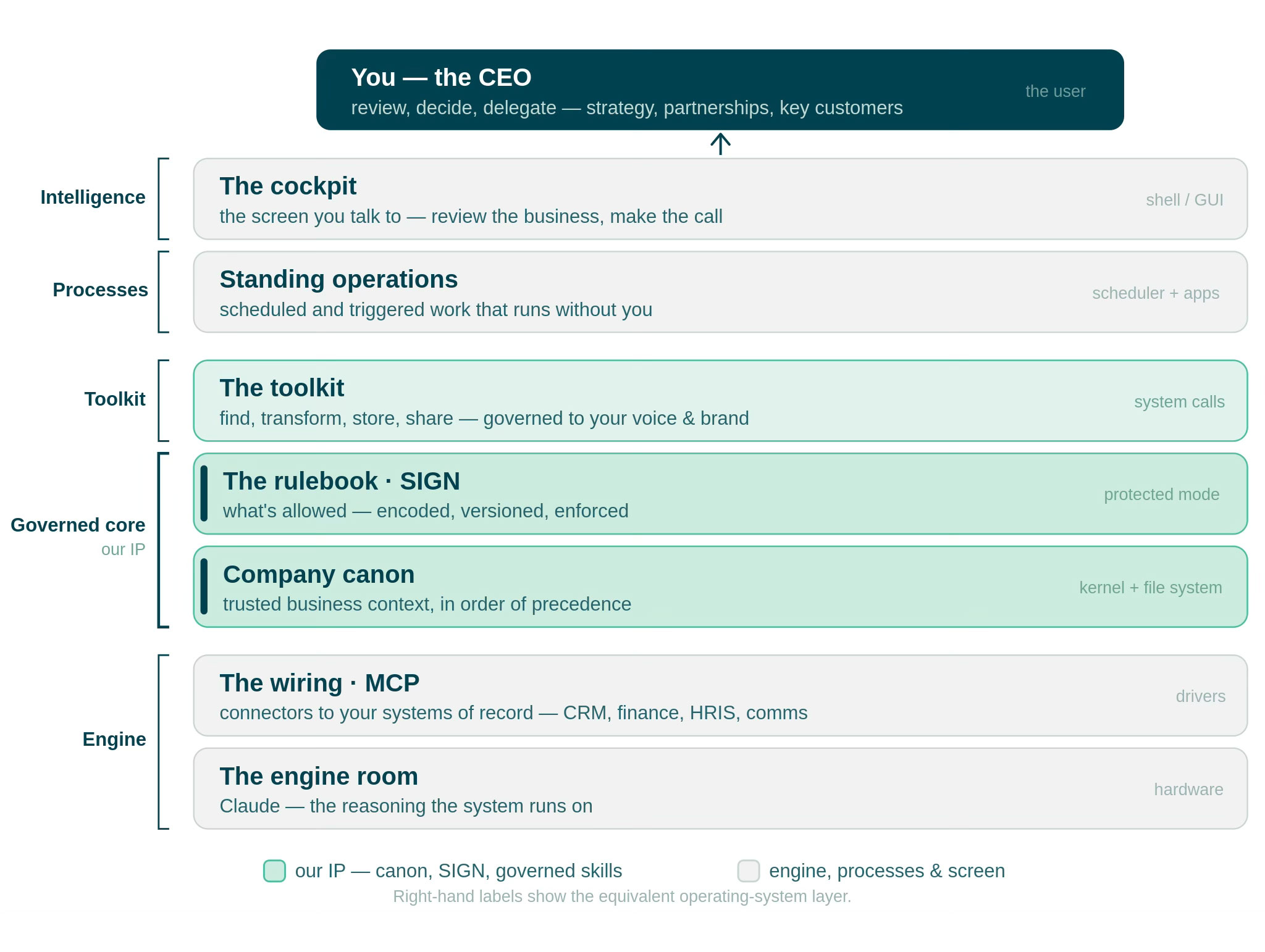
Over the past month I have assembled what I can only describe as an operating system: a layered stack, built on Claude, that does the work a company generates so I can spend my time on the work only a CEO can do. It has the same shape as the operating system on the device you are reading this on — and that shape is the point. I will walk it layer by layer and show how each one is built.
What an operating system is for
An operating system earns its keep by doing two things at once. It abstracts the machine, so you work at a high level instead of flipping bits. And it governs access, so the things that must be reliable stay reliable no matter what runs on top.
Hold onto that word: governance. Almost everything that separates my system from a clever assistant — or a second brain — comes down to it: a privileged, trusted core that decides what is true and what is allowed, with everything else running above it. Strip the governance out and you do not have an operating system. You have a chatbot with good intentions.
Here is the full stack.
The engine
At the very bottom is the reasoning the whole system runs on — and after a real search, that is Claude. I did not start here. We worked through Copilot, then Perplexity, then ChatGPT, and settled on Claude. It is not that the others can’t do this, it is that Claude is the only one that could operate every layer of this stack — a connected through-line from the engine to the screen. It reaches our systems of record, runs the skills, executes the scheduled processes, and holds to our standards across all of it. The others answer questions. Claude runs the system.
Above the engine is the wiring — the connectors that let the system reach the tools the business already runs on, through MCP. I deliberately think of these by category, not brand: the CRM, the financial system, the HRIS, the email and messaging layer, any system of record. The goal is a true driver layer — that you can swap a tool underneath and everything above keeps calling the same operations while the wiring handles the translation. We are not quite there yet, but that is the direction.
These connectors have one property worth flagging now: some can write back, and some can only read. That single difference decides whether a whole process can finish inside the system or stalls at the screen you were trying to leave. I will come back to it.
The governed core
The next two layers are the ones almost everyone skips — or cannot implement — and they are the entire reason this works. They are also where our proprietary IP lives. Together they are the governed core: the trusted context the system runs on, and the rules that govern what it may do.
Start with canon. Every operating system has a file system — a structured, persistent record of what the machine knows. Ours is our company canon: our single source of truth. It is our trusted business context — definitions, strategy, standards, the design system, operating concepts — written down once and treated as authoritative. It is not a folder of notes, our Sharepoint or a Google Drive connected to the system. Our canon is consulted in a strict order of precedence, so the system always reaches for the most authoritative context available before anything lower down: true canon first, company data, and then other ranked sources.
Canon is the thing you actually run a company on, and it is what lets you automate a process with confidence. When a function needs a fact or a standard, it reads from canon. Other systems may not invent an answer outright, but without a governed source of truth you never know which version you will get — the whole junk drawer is on the table to choose from. Canon takes the junk drawer away.
Then the rules. A real operating system does not let every program do everything; it has a protected mode that gates privileged actions so one misbehaving program cannot corrupt the machine. Ours are governed by SIGN — a specification language we built to encode our policies, standards, data and boundaries in an explicit, machine-checkable form. The rules do not just sit in a document; SIGN’s guidelines let agents reason over our enterprise knowledge in a governed manner — so when the system acts, it is reasoning within the lines we have drawn, not improvising around them. Changing a policy or the ruleset in SIGN is itself governed — proposed, reviewed, and published to the system — so the boundaries stay authoritative instead of drifting.
A concrete one: a process can review a deal and recommend moving it forward, but it cannot advance a deal past Qualified to Buy on its own. That takes me. The intelligence on top can propose; it cannot cross the line the rulebook draws. Recommendation is cheap; authority is governed.
The toolkit
On top of the governed core sit the core functions — the system calls. I started here, with the mundane things I was spending an inordinate amount of time on: finding information, transforming it, storing it, sharing it. Find, transform, store, share, review — the small, reliable operations everything else is built from.
These are skills I built once and now invoke constantly, and the important thing about them is what they govern. One does not just write a document — it writes in our voice. One does not just make a deck — it makes one to our brand standard. One takes a messy contract and standardizes it to our format, clause by clause. These skills carry the voice and the standards into every output, so find happens in a precedented way and transform lands on brand every time, no matter who runs it.
Because each skill reads from canon and obeys the rulebook, the same skill produces the same quality for anyone in the company.
Standing operations
Above the toolkit is where the system stops waiting to be asked.
These are standing operations — processes I built once that now run on a schedule or a trigger, each chaining the toolkit’s functions into real work. The system does research and writes first drafts of articles. It reviews the week’s news and social and drafts the posts. It reviews my pipeline and flags what has stalled. It handles customer and prospect follow-up, prepping me before a meeting and capturing commitments after. Every Monday morning a dashboard assembles itself from live CRM and financial data and lands in my inbox before I am awake.
None of these is a prompt I retype. Each is a standing process — scheduled or triggered — that runs the toolkit’s functions on its own. And this is not only mine: everyone in the company builds their processes on the same toolkit, composing the same governed functions into the work their role needs. One shared foundation, many processes.
The round trip
This is the property I flagged earlier: a process only completes if the system can write back, not just read.
Pulling data out of a tool is easy. The test is whether you can push the result back in — close the loop — without a human re-keying it through a screen. When that round trip works, an entire workflow can run inside the system: read the data, do the work, write the result back to the system of record, automate the whole thing.
This is why I run my task list in Notion and draft in Superhuman. I read, transform, write back, and let the process run end to end. When the round trip is open, a tool becomes a place the system can operate, not just observe. I say more in a companion piece about what this means for the tools that don’t allow it — because it is a bigger deal than it first appears.
The cockpit
The top layer is the one I touch.
This is the screen — where I stop operating the machine and start operating the business. I ask how we are doing, and the system pulls the live picture: pipeline, cash, what is stalled, where risk is concentrating. I do not assemble the report. I read it, and then I do the part that is actually mine — decide, delegate, set direction. And when I need something built, I reach straight past the screen and call any function in the toolkit on demand.
Everything below this layer exists so that this layer is all I have to touch.
Why this works
Step back, and the value is not where most people look. The engine is Claude — extraordinary, and available to anyone. The connectors are standard. The screen I talk to is the easy part, and the standing processes are just the toolkit on a schedule. Strip all of that away and what is left — the part nobody can copy from us — is the governed core: our canon and our rules, written in SIGN and reached over MCP.
Canon, SIGN, and the wiring that lets them act: that is the differentiator. It is also why automation is trustworthy here and brittle elsewhere. A second brain, or an agent loose in a folder, has the engine and the apps and the screen; what it lacks is a governed core, so it drifts. Ours does not, because every layer above reads from trusted context and obeys encoded rules.
And because the core is governed rather than personal, this is not really my operating system. It is the company’s operating system. The same context, the same standards, the same rules are available to anyone — so the business runs the same way no matter who is at the keyboard, and whether the work is done by a person, a person with AI, or fully automated.
Which is the whole ambition. The old adage is to make money while you sleep. I want more than that — I want the company to run while I sleep, to our context and our standards and our policies, and then to hand me, in the morning, only the decisions that were ever really mine.